High-Level Roadmap
Below is a comprehensive, step-by-step plan to apply the Code2Product lessons to Ton Arcana, adapting them to a part-time schedule with heavy AI assistance. Each phase includes milestones, deliverables, acceptance criteria, and a roadmap for transforming Ton Arcana from a technical prototype into a market-ready product. The plan assumes you're working part-time (e.g., ~10–15 hours/week) and leveraging AI tools (like ChatGPT, Ollama, and other automation platforms) to streamline research, content creation, user interviews, and marketing tasks.
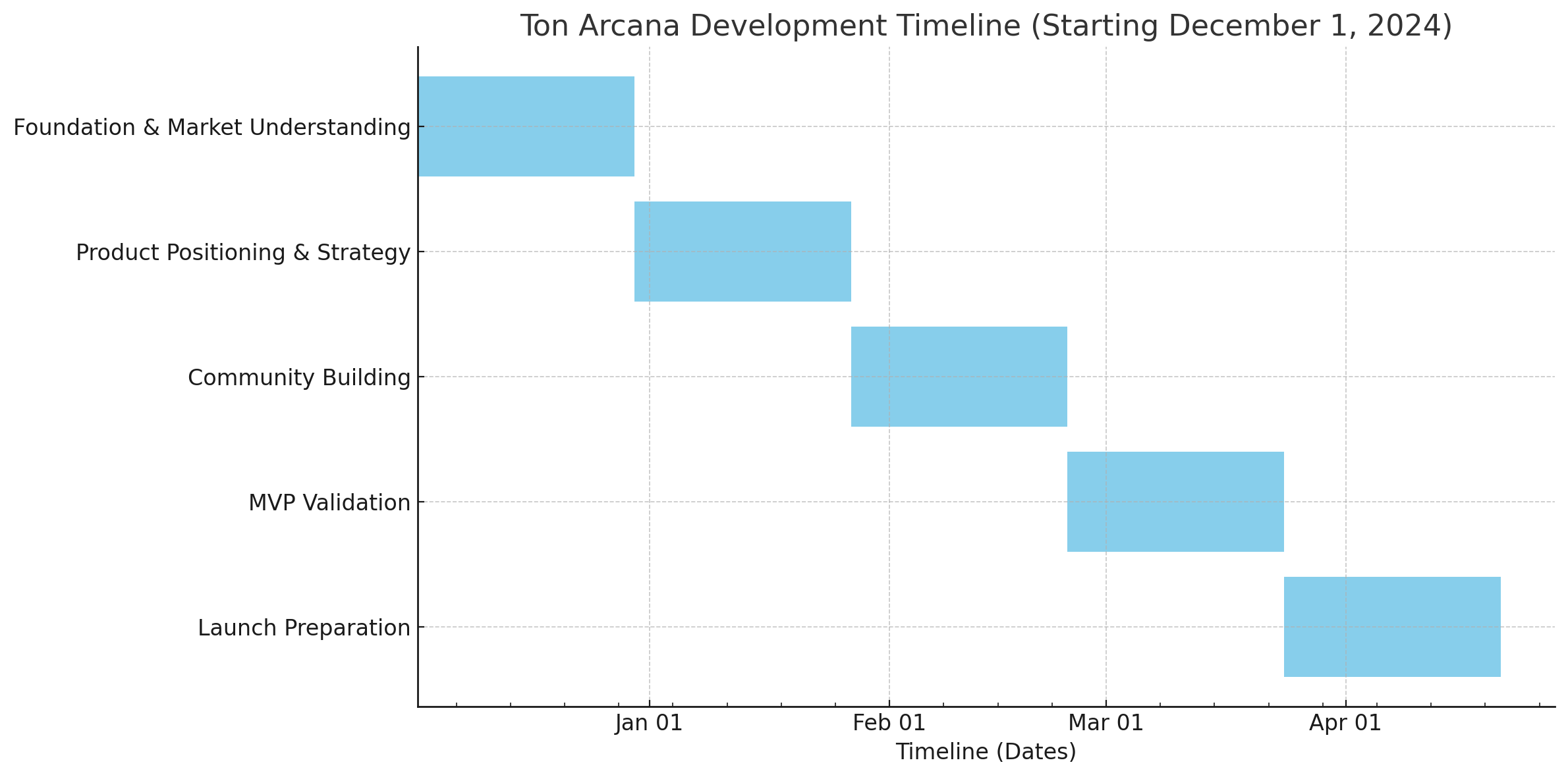
Development Timeline
id: product_roadmap
High-Level Roadmap
-
Foundation & Market Understanding (Weeks 1–4)
- Identify Product-Avatar
- Conduct Customer Interviews & Understand Customer Journey
- Define Units of Value, Segments, Funnel, & Basic Economics
-
Refine Product Positioning & Strategy (Weeks 5–8)
- Build One-Page Business Model & Expanded Product Line
- Recruit Initial Team Members (Marketing, Sales)
- Create Persona, Customer Journey Map (CJM), User Stories, JTBD
-
Community Building & Competitive Edge (Weeks 9–12)
- Formulate Community Strategy
- Execute Marketing & Growth Plans (Paid Ads, Virality, UGC)
- Define Competitive Positioning & Differentiators
-
Scaling & Validation (Weeks 13–16)
- Conduct Additional Customer Development Interviews
- Launch MVP to Early Adopters
- Track Retention, Improve Unit Economics & LTV
-
Long-Term Growth & Launch Preparation (Weeks 17–20)
- Finalize Marketing Campaigns & Channels
- Establish Strong Community Engagement
- Prepare for Public Launch & Growth Phase
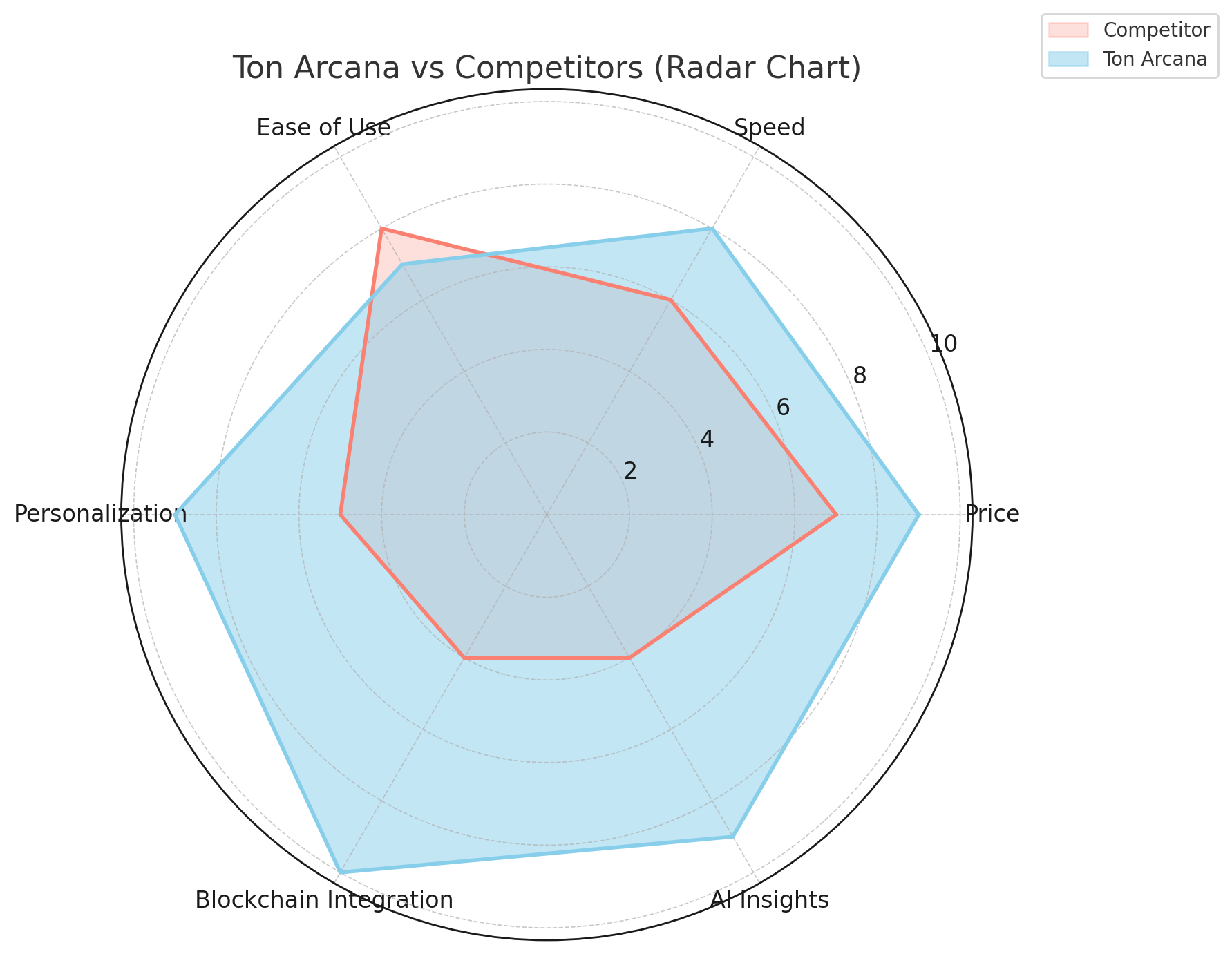
Competitive Analysis
id: product_roadmap
Detailed Plan by Lessons
Weeks 1–4: Foundation & Market Understanding
Objectives:
Validate demand for AI-driven tarot readings, understand target audience and competitors, and ensure unit economics are viable.
Tasks (Lessons 3–9 Integration):
-
Identify Product-Avatar & Conduct Interviews (Lesson 3 & 4)
- Action:
- Choose a known online tarot reading platform (e.g., Kasamba) as product-avatar.
- Use AI to generate a cold outreach script to interview 5–10 users.
- Milestones & Deliverables:
- Completed interviews with at least 5 users who purchased tarot readings online.
- Documented findings on user needs, decision-making process, and pain points.
- Acceptance Criteria:
- Interview notes that clearly show user motivations, purchase triggers, and evaluation criteria.
- Action:
-
Define Sales Funnel & Hypotheses (Lesson 5)
- Action:
- Using interview insights, define Ton Arcana's funnel:
Impressions (Telegram Ads) → Free Daily Pull → Paid Reading Offer → Subscription
- Using interview insights, define Ton Arcana's funnel:
- Milestones & Deliverables:
- A Google Sheet with funnel stages, conversion rates (assumptions), time between stages, and top 3 hypotheses for doubling sales.
- Acceptance Criteria:
- Funnel diagram & metrics ready for internal review.
- Action:
-
Define Units of Value, Segment, & CAC (Lessons 6–8)
- Action:
- Unit of Value: One full paid reading session.
- Segments: (1) Spiritual seekers interested in tarot (2) Crypto-enthusiasts who value novelty & token-based services.
- Estimate CAC using Telegram ads and AI-driven keyword research.
- Milestones & Deliverables:
- Document listing units of value, top 2 segments' profiles, and a rough CAC calculation.
- Acceptance Criteria:
- A final doc with units, segments, and CAC < LTV.
- Action:
-
Unit Economics Check (Lesson 9)
- Action:
- Calculate contribution margin and ensure positive margin per reading.
- Milestones & Deliverables:
- Unit economics spreadsheet with average check, CAC, and variable costs.
- Acceptance Criteria:
- Positive contribution margin or clear plan to achieve it.
- Action:
Outcome by Week 4:
You have clarity on your target users, how they find value, a basic funnel, viable unit economics, and initial customer insights.
id: product_roadmap
Weeks 5–8: Refining Product Positioning & Strategy
Objectives:
Formulate a crystal-clear product strategy, finalize business model, begin building a small team, and create persona and CJM.
Tasks (Lessons 10–15 Integration):
-
One-Page Business Model (Lesson 14)
- Action:
- Summarize the entire business model in one page using insights from previous lessons.
- Milestones & Deliverables:
- Google Doc with all 12 key blocks: What/Whom, How, Need, Competitors, Advantage, Tech, Market, Funnel/CAC, Economics, MVP, Team, To-Do.
- Acceptance Criteria:
- One-page doc reviewed by a mentor or trusted advisor.
- Action:
-
Recruit Marketing Specialist (Lesson 10)
- Action:
- Draft a recruitment email using AI for personalization and clarity.
- Post the job description on relevant communities.
- Milestones & Deliverables:
- Recruitment outreach messages sent to at least 5 candidates.
- Acceptance Criteria:
- At least 2 interviews scheduled with qualified marketers.
- Action:
-
Retention Modeling & Sales Specialist Recruitment (Lesson 11)
- Action:
- Create a 12-month retention projection in a spreadsheet.
- Write a recruiting message for a sales specialist and send it out.
- Milestones & Deliverables:
- Retention model (with monthly active users, ARPU) and at least one promising sales candidate short-listed.
- Acceptance Criteria:
- A realistic model showing a path to 10M rub/month revenue by month 12.
- Action:
-
LTV, ROI, & Elevator Pitch (Lesson 11, second part)
- Action:
- Calculate LTV, 30-day ROI on main channel, and draft an elevator pitch.
- Milestones & Deliverables:
- Final LTV/ROI doc and polished elevator pitch posted in internal docs.
- Acceptance Criteria:
- Elevator pitch clear and under 30 seconds.
- Action:
-
Expanding Product Line (Lesson 15)
- Action:
- Brainstorm with AI 5–10 additional products (premium readings, subscription tiers, educational courses, referral programs).
- Milestones & Deliverables:
- Product line matrix with pricing and target audience.
- Acceptance Criteria:
- Product line validated by at least one potential user interview.
- Action:
Outcome by Week 8:
A refined, investable product strategy, initial hires for marketing/sales underway, a defined product line, and metrics that support scaling.
id: product_roadmap
Weeks 9–12: Community Building & Competitive Edge
Objectives:
Establish a community to differentiate Ton Arcana ideologically against outdated competitors. Define content strategy and growth drivers.
Tasks (Lessons 16–18, 13):
-
Community Strategy & Ideological Positioning (Lessons 16 & 17)
- Action:
- Identify ideological competitor (traditional expensive tarot services).
- Plan content (5 headlines, weekly content plan) and distribution (5 platforms).
- Milestones & Deliverables:
- Community guidelines, Telegram group or FB group created, initial 7-day content calendar posted.
- Acceptance Criteria:
- 50+ early community members joined and engaged.
- Action:
-
Growth Drivers (Lesson 13)
- Action:
- Choose top 3 growth drivers: Paid ads, referral program (virality), and UGC (testimonials).
- Milestones & Deliverables:
- Growth strategy doc detailing these drivers and step-by-step plan.
- Acceptance Criteria:
- Approval by marketing specialist and initial test budget allocated.
- Action:
-
Write a Competitor Contrast Post & Promote (Lesson 18)
- Action:
- Publish a post that calls out competitor weaknesses and invites readers to community.
- Milestones & Deliverables:
- Post published on chosen platforms (Reddit, Telegram, LinkedIn).
- Acceptance Criteria:
- Increased community sign-ups (at least 20 new members from the post).
- Action:
Outcome by Week 12:
A nascent community aligned with your ideology, a clear content and growth plan, and early signs of community-driven traffic.
id: product_roadmap
Weeks 13–16: Scaling & Validation
Objectives:
Refine persona, create CJM, user stories, and JTBD. Launch MVP to early adopters and iterate based on feedback.
Tasks (Lessons 19–20, re-checking earlier lessons):
-
Persona & CJM (Lesson 19)
- Action:
- Create persona in UXPressia and map their journey with Ton Arcana.
- Milestones & Deliverables:
- Exported Persona & CJM PNG and doc with top 5 clarification questions for future interviews.
- Acceptance Criteria:
- Persona and CJM reviewed by team; no contradictions found.
- Action:
-
User Stories & JTBD (Lesson 20)
- Action:
- Generate 5 user stories and 5 JTBD using AI, informed by persona & CJM.
- Add keyword research (Google Keyword Planner) and Facebook targeting suggestions.
- Milestones & Deliverables:
- A feature backlog doc with user stories & JTBD.
- Acceptance Criteria:
- Stories handed off to dev for refining MVP features.
- Action:
-
Launch MVP to Early Adopters
- Action:
- Provide selected community members with a code/token to try paid readings at a discount.
- Milestones & Deliverables:
- MVP live, 20–30 early adopters onboarded, collecting feedback via a short survey.
- Acceptance Criteria:
- At least 15 feedback responses with actionable insights.
- Action:
-
Refine Unit Economics with Real Data
- Action:
- Recalculate CAC, retention, and ARPU with actual early adopter data.
- Milestones & Deliverables:
- Revised spreadsheet with updated metrics.
- Acceptance Criteria:
- Positive trends (improved conversion, stable retention).
- Action:
Outcome by Week 16:
Valid, refined persona/JTBD, tested MVP, and improved metrics based on real user data, guiding further development.
id: product_roadmap
Weeks 17–20: Long-Term Growth & Launch Preparation
Objectives:
Finalize marketing campaigns, scale community engagement, prepare for public launch with improved product-market fit.
Tasks (Lessons 21–22 and final touches):
-
Additional Customer Development (Lesson 21)
- Action:
- Conduct 5 more interviews with more targeted audience segments.
- Milestones & Deliverables:
- Document answers regarding spending, decision-making, comparison, communities, and scale potential.
- Acceptance Criteria:
- Confirmed alignment of product features with user needs and a pipeline of 100+ potential users for future interviews.
- Action:
-
Competitive Edge (Lesson 22)
- Action:
- Rate competitors vs. Ton Arcana and create a radar chart.
- Finalize positioning statement emphasizing token-based, AI-driven uniqueness.
- Milestones & Deliverables:
- A visual comparison chart and a 2-3 line positioning statement posted on the landing page.
- Acceptance Criteria:
- Clear, compelling competitive narrative validated by at least 2 early adopters.
- Action:
-
Final Marketing Push & Launch Prep
- Action:
- Launch a targeted marketing campaign using chosen growth drivers.
- Prepare PR materials, finalize website copy, and ensure telegram bot stability.
- Milestones & Deliverables:
- Website landing page optimized, final PR kit ready, at least one influencer collaboration set.
- Acceptance Criteria:
- Public launch date set, early sign-ups start flowing in from campaigns.
- Action:
Outcome by Week 20:
A well-positioned, market-tested product ready for broader public launch, strong community support, validated economics, and a marketing strategy in place.
id: product_roadmap
Acceptance Criteria & Success Measures
-
Product-Market Fit Indicators:
- At least 20 paying users within the MVP test phase.
- Positive user feedback indicating meeting a real need (qualitative surveys).
-
Unit Economics & Growth Metrics:
- CAC < LTV demonstrated with initial users.
- Positive ROI at Day 30 from at least one paid channel.
-
Community & Branding:
- Engaged community with 100+ members discussing readings, sharing experiences.
- Clear ideological stance differentiating Ton Arcana from old-school alternatives.
-
Team & Operations:
- At least one dedicated marketing specialist and one sales specialist recruited.
- Basic operational processes (support, feedback collection) documented.
id: product_roadmap
Heavy AI Involvement
-
Interview Prep & Summarization:
Use AI tools to draft interview outreach scripts, summarize interviews, and identify patterns. -
Content Creation:
AI to generate blog posts, social media copy, competitor contrast posts, and community engagement content. -
Market Research & Keyword Analysis:
AI-assisted keyword brainstorming, competitor analysis, and funnel optimization suggestions. -
Documentation & Reporting:
Use AI to produce weekly reports, refine your elevator pitch, and generate structured action plans.
id: product_roadmap
Conclusion
By following this phased approach, working part-time and leveraging AI heavily, you can systematically transform Ton Arcana from a technical side project into a customer-centric, economically viable, and community-driven product. Each milestone ensures you're building on validated knowledge, refining economics, and strengthening market positioning, setting the stage for a successful launch and sustainable growth.